Toy aisle · “But I need it”
They want it now
Say this now“You really want it. We are not buying it today. We can put it on a wish list.”
- Before a shop, name the plan: “We’re buying dinner, not a toy.”
- In the moment, name the feeling and repeat the limit once.
- Talk about the choice later, when everyone is calm.
If your child is overwhelmed: leave the lesson for later. Help your child feel safe and finish what you need to do. A wish list helps you remember; it is not a promise to buy.
Read the full guide →
Starting pocket money
How much should I give?
Start hereThere is no right amount. Choose what your family can keep up, even if that is £0 for now.
- Pick an amount that does not put pressure on the household budget.
- Choose a regular day and say what the money is for.
- Try it for four weeks, then review it together.
No spare money? Use five play coins in a paper shop. Do not use national averages as a target for your family.
Read the pocket-money guide →
Pocket money and jobs
Should I pay for chores?
A middle way“We all help with normal family jobs. We can agree pay for an extra job.”
- Choose your family rule. Pay can be regular, earned, or a mix.
- For a paid extra job, agree the job, finish line and pay first.
- Keep food, care and family love separate from earning.
If the job is not finished: no pay for that optional job is a clear result. There is no need for shame or a long lecture.
Compare the three choices →
A small mistake
They spent it all
Start without blame“You’re not in trouble. Let’s work out what happened, then we can plan what to do next.”
- Ask what happened. Check whether it was their choice or someone tricked or pressured them.
- If it was their own small choice, protect needs and do not rush to replace the money.
- Before next time, draw one small goal and mark its price.
If someone tricked or pressured them: this is not a “natural consequence”. A grown-up steps in and sorts out safety first.
Help them plan the next try →
Card · Phone · Contactless
The tap looks like free money
Say this at the till“The tap starts a real payment. It does not make the money free.”
- Name one price before you pay: “These apples cost £2.”
- Use the right words: debit usually uses account money; credit is borrowing.
- At home, tap a paper card and cross out play coins.
Keep details private: your child does not need to see a PIN, balance or bank screen. A price label or drawing is enough.
Make a tap visible →
Robux · Coins · In-app buys
A game asks for money
Family rule“If a screen asks for money, a password, a code, your name or a photo, stop and show me. You are not in trouble. Only a grown-up presses the final buy button.”
- Turn on adult approval and keep the password private.
- Remove stored payment details if you do not need them there.
- If money was spent, check the receipt and use the official help route quickly.
Do not promise a refund. Apple, Google and game firms decide each request. Report a payment you do not recognise to the payment provider too.
Protect first, teach second →
When the budget is tight
What do I say?
Keep it true and short“That is not in our spending plan today. Money is a grown-up job. You do not have to fix it.”
- Answer the question they asked, without giving adult-sized detail.
- Offer a no-cost choice when you can: park or drawing, now or later.
- Keep balances, debt and worry with the adults who can act on them.
If you feel upset: it is fine to pause and come back. Your child does not need you to pretend money is easy.
Read the no-judgement guide →
No spend · Five minutes
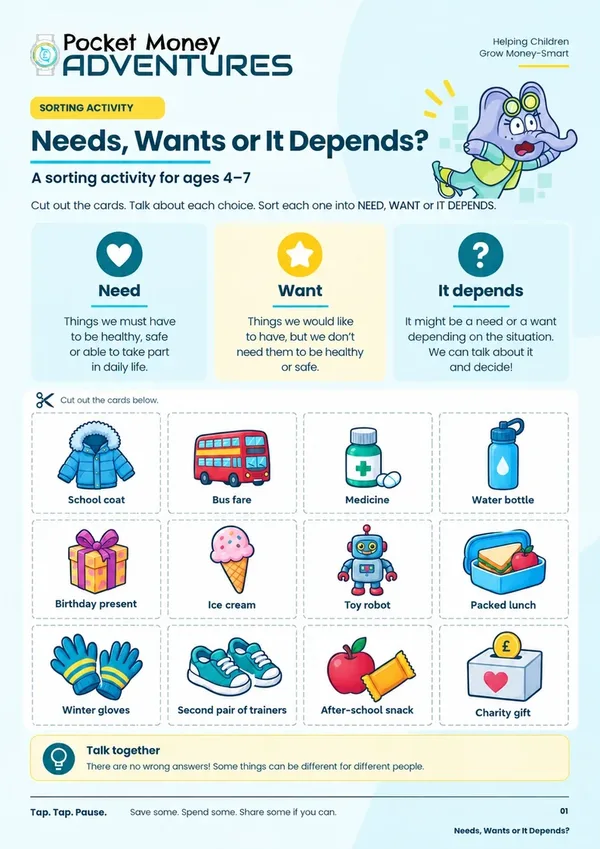
I need one simple activity
Try a paper shop“We have five play pounds. This costs two. What is left after we pay?”
- Draw five circles, or use five blocks or buttons.
- Tap, point to or move a blank card, then remove the price.
- Count what is left. Pointing, signing, AAC, eye-gaze or watching is fine too.
Make it fit your child: use pictures, fewer choices, movement or a quiet break. Your child can also pass. It is play, not a test.
Get the free printables ↗