“Can I have it?” is a familiar question for parents and a familiar moment in a classroom play shop. A child may know what an item costs and still need help to see what buying it would mean for their other plans.
There is a feeling in that moment too. A child may be excited about something they want, disappointed that they cannot have it, or finding it hard to wait. We want to acknowledge that feeling as well as explore the money choice.
Pocket Money Adventures puts Tap Tap Pause at the centre of money learning for children aged four to seven. Through stories and play, children practise looking at their options and making a choice they can explain or show.
What Tap Tap Pause means
Tap Tap Pause is one short routine: two gentle taps followed by a pause for one breath before choosing. A grown-up models it, and the child can join in using a comfortable tapping action. A breath, a pause card or another agreed cue can be used if tapping does not work for them.
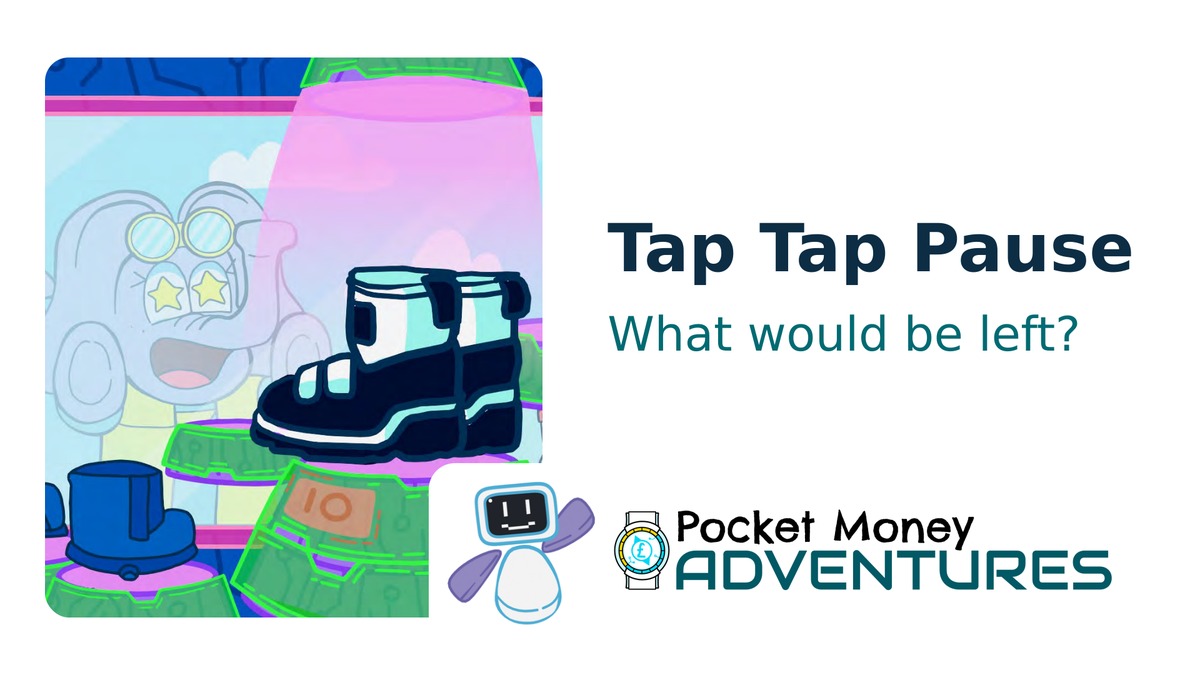
After the pause, begin with one question, such as “What would be left?” Add questions about the price, needs and wants, or the child’s plan when they are ready. Keep the information visible and give the child time to think. They can choose, wait or ask for help.
Why we use a bucket
Picture water in a bucket. The water matters, and the bucket lets you carry it and use it. In our teaching analogy, the water is money knowledge: recognising coins, understanding prices and learning about saving, spending and sharing.
The bucket is a practised way to use that knowledge: pause, consider the options and think about what a choice changes. Knowing a price is useful. Seeing what paying it would mean for another plan brings that knowledge into a decision.
Tap Tap Pause introduces that process. Ava’s choices give children something to discuss. Counters make costs visible. A picture of a saving goal keeps their plan in view. We introduce the routine early, while money knowledge and decision practice develop together.
The mistake is stopping at a correct answer
The mistake is assuming that a child who can answer a money question will automatically use that answer when choosing. A correct answer tells us something valuable about their understanding. They also need opportunities to practise what the answer means for a decision.
Imagine a character with five counters, each worth one unit of play money. They plan to buy a toy costing five another day. A sticker costs two. A child may know the sticker’s price; the next thing to explore is what buying it would change.
The difference we want to make
We want children to have a way to approach that choice. Using Tap Tap Pause, they can look at the five counters, see that buying the sticker would leave three, and consider what that means for their toy.
They might keep the five for the toy. They might prefer the sticker and accept that the toy will have to wait. Help them understand what their choice changes. Saving the most is not automatically the measure of success.
Save some. Spend some. Share some if you can. Spending belongs in the conversation, and sharing stays optional.
The difference we are aiming for is a child who can use the routine and their learning independently. The bucket describes our teaching approach; whether children use what they learn later, in a different situation, needs research evidence.
Try it with a child
You can try this together at home or in class. You need five large counters, a sheet of paper and two drawings. No printing, purchase or real money is needed. Each counter is worth one unit of play money.
You set the boundaries. A play shop gives children a choice to explore safely, within limits you have agreed.
- Give a story character five large counters, each worth one unit of play money. Draw or describe a toy costing five. The character plans to buy it another day. Show, say or sign the prices and plan in a way that works for the child, and check they understand.
- Introduce a different item, such as a sticker costing two. Use Tap Tap Pause together before exploring the choice.
- Move two counters into a payment area to show what buying the sticker would do, leaving three. Let the child handle the counters, or show the change in another accessible way.
- Ask: “Could the character still buy the toy with what would be left?” Three is less than five, so the character would need two more before buying the toy. Give help if it is needed.
- Put all five counters back, then let the child choose for the character. Help them explore what each choice changes. They can speak, sign, point or show you with objects, using their usual communication support.
For a simpler version, use three counters, a toy costing three and a sticker costing one. Keep the cost and remaining amount visible. If the child misunderstands the price or balance, help them check it before deciding.
Make it work for your child or class
Children can join in through speech, signing, pointing, drawing or familiar communication support. Keep the opportunity to look and choose, using an agreed alternative cue if tapping is uncomfortable or inaccessible.
Teachers can use a character’s choice in a play shop or after shared reading. England’s Year 1 maths programme already includes recognising coins and notes. This activity brings counting together with a conversation about what a purchase changes. [1]
Use made-up situations, so children do not need pocket money or have to explain what their family can afford. Our free activity library includes adapted packs.
Try another choice on another day
On another day, change the play items. Keep the amounts, prices and plan clear, then notice what the child tries before offering a reminder. Keep their usual access and communication support available, and give help when they need it. One activity is a useful conversation, not proof of lasting independent learning.
Start with the free activities
The Starter Mission Book includes a play shop, a saving goal and other short activities. Colour, print-friendly, fillable and adapted versions are available. No sign-up or real money is needed.
Choose one activity and try it with a child or your class. Ask them to show what their choice would leave, and listen to their explanation.