When a Pocket Money Adventures session is finished, we want the learning to stay. A child may enjoy the story, join in with Tap Tap Pause and explain a choice during the activity. We also want to understand what happens later, when the situation changes and they have not been reminded to use the routine.
Working with parents, teachers and children in schools, libraries and community settings has sharpened that ambition. Our aim is for children to have something useful to draw on when their next money choice comes along.
That moment has feelings in it too. A child might be excited about something they want, disappointed that they cannot have it, or finding it hard to wait. We want those feelings to be heard, alongside exploring what the choice would change.
Build on what children already learn
Counting, recognising money and understanding prices matter. England’s Year 1 maths programme already includes recognising coins and notes. We want to build on that learning through opportunities to explore a choice. [1]
There is also a case for broadening the opportunities children get. In its May 2024 report, the House of Commons Education Committee argued that primary financial education should go further, including beyond calculations with money in an increasingly cashless world. [2]
The part we want Pocket Money Adventures to contribute is practice with the decision itself. What is available? What would a purchase leave? Does that still fit the child’s plan? Understanding the numbers and using them in a choice belong together.
Give the pause something useful to do
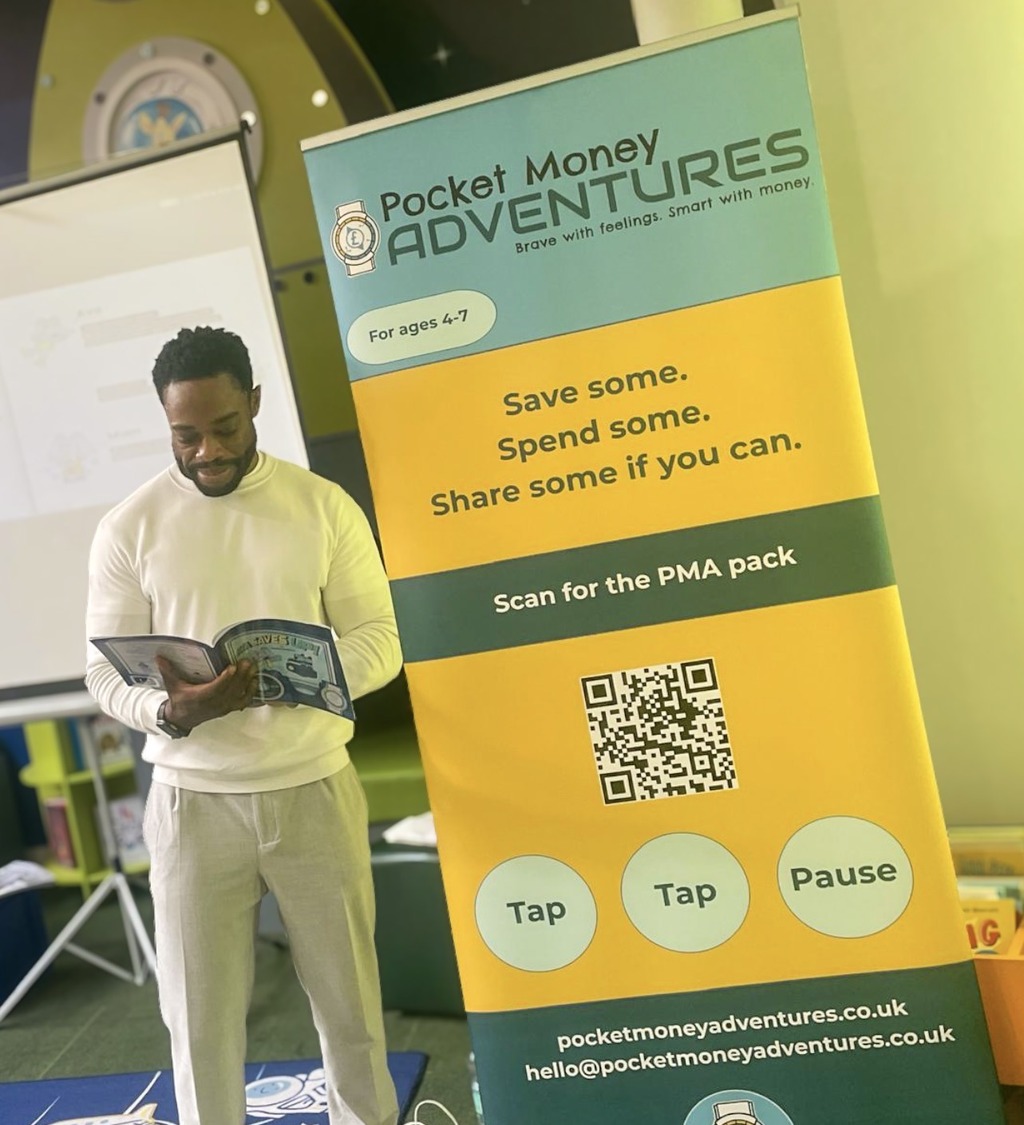
Tap Tap Pause sits at the centre of our approach: two gentle taps followed by a pause for one breath. A grown-up models it, with a comfortable alternative cue available if tapping does not suit the child. Stories and play then give us a choice to explore together.
The information around that moment matters. A drawing of a saving goal, visible counters or a clear remaining balance gives the child something to work with. Saying “think about it” is much less useful if the child cannot see what the choice changes.
Ava gives us a character whose choices children can discuss. They can talk about what she wants and what she could do, then try a made-up choice themselves. No child needs to disclose what their family earns or can afford.
The same principle matters when a payment is made by phone or card. In a play payment, we can still show what was available, what was paid and what remains. Making the cost clear is a teaching aim; creating worry about spending is not.
Ask what survives the teaching
Research into young children’s learning gives us reasons to examine these ideas carefully. It also warns us against assuming that a strategy taught in one activity will give an advantage in another.
A 2024 card-sorting study trained four-year-olds to use labelling or pointing strategies. On new cards, trained children continued using those strategies, but the groups did not differ significantly in identifying the task’s goal. It was not a money study or a test of Pocket Money Adventures. It shows why using a taught strategy and gaining a benefit from it are separate things to examine. [3]
Our founder, Nathan Waldron, is developing a doctoral research proposal around independent use of money learning. The proposal would compare teaching approaches and examine what happens later in different money-choice situations, without reminders to use the taught strategy. Prices and balances would still be clear, and children’s usual access and communication support would remain available.
That distinction matters. Removing a reminder should let us examine what a child has learned; it should not quietly turn the activity into a harder test of remembering the price.
The proposal is still being developed. A useful result could show where the routine adds value, where support remains important or where the design needs changing. We want the research to inform what we teach next.
Make the learning worth using
For a parent, this needs to be something they can try without buying materials or turning family life into a finance lesson. For a teacher, it needs to sit comfortably alongside shared reading, counting and play.
Our free activity library already gives families and settings a place to start, with made-up choices and adapted versions. The school programme includes an opening story session and short teacher follow-ups. Returning to the learning is part of the delivery design; whether that produces lasting independent use needs its own evidence.
Spending is part of this too. A child who understands a purchase and chooses it may be making a reasonable decision. Saving the most should not automatically be the definition of success. Children should be able to reconsider a goal and explain or show what their new choice means.
Save some. Spend some. Share some if you can. Those last four words matter: sharing is an option, never a test of whether a child is good or generous enough.
Give support a clear purpose
Sponsors can help fund books or a classroom programme that is free to the school. That creates access to stories, resources and opportunities to practise. The agreed delivery should be recorded, and any learning evidence should be described accurately.
We want a sponsor to be able to see what their support provided. A book distributed, a session delivered and a measured change in a child’s learning are different things. Keeping those records clear helps us build a stronger organisation and make better decisions about expansion.
Financial education also sits within a much bigger picture. Families face pressures that a lesson cannot remove. Children should never be made responsible for solving household financial difficulty, and Pocket Money Adventures should not promise that an early routine will prevent adult debt.
The next “Can I have it?” may happen long after we have packed the books away. We want the learning to be useful there, too: room for the feeling, time to look at the choice and a child who feels heard. Finding out how much children can use independently is the next question we want to investigate.